
Media Reference and Citations
May 1, 2026
Over the past few months Orientation and has been continually referenced and quoted, by business and law media outlets, for contributions and insights on modern slavery risk at the intersection and business and human rights.
Some of the excerpts are listed below:
---
September 26, 2025
CommonWealth 天下雜誌
US Customs Blocks Giant’s Taiwan-Made Bikes Over Forced Labor Allegations
"Taiwan’s manufacturing sector employs around 530,000 migrant workers, and a 2024 report by the US-based advocacy group Orientation listed Taiwan as a high-risk country for forced labor and modern slavery in supply chains. Meanwhile, new human rights due diligence laws in Germany and the EU will soon require companies to screen supply chains for such risks."

---
November 2025
KPMG
2025年永續評比重點和台灣企業表現回顧與 展望: 台灣⼈權現況:整體穩定 但國際壓⼒升⾼
Key Points of the 2025 Sustainability Assessment and Review and Outlook of Taiwanese Companies' Performance: Current Human Rights Situation in Taiwan: Overall Stable but International Pressure is Rising
另外,美國移⼯倡議組織 Orientation去年報告則指出,有33家跨國企業及兩個歐洲政府部⾨,已明確將台灣認定為供應鏈強迫勞動和現代奴役的⾼風險或重點地區。
In addition, last year's report by the U.S. migrant labor advocacy organization Orientation pointed out that 33 multinational companies and two European government departments have explicitly identified Taiwan as a high-risk or priority area for forced labor and modern slavery in the supply chain.
---
October 7, 2025
CommonWealth 天下雜誌
巨大勞動風波後 專訪全球前三鮪魚商:為何供應商少一半,也要幫漁工裝WiFi
Following a massive labor dispute, an interview with one of the world's top three tuna suppliers reveals why they are still providing WiFi for fishermen even with half the number of suppliers.
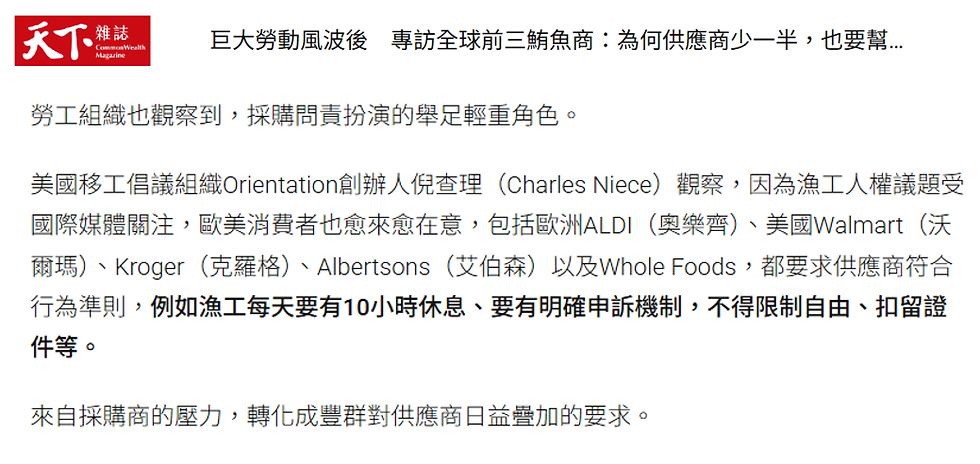
"Labor organizations have also observed the crucial role that procurement accountability plays. Charles Niece, founder of the US-based migrant worker advocacy organization Orientation, observed that as fishermen's human rights issues have garnered international media attention, consumers in Europe and the US are becoming increasingly concerned. Companies including ALDI in Europe, Walmart, Kroger, Albertsons, and Whole Foods in the US all require suppliers to comply with codes of conduct, such as requiring fishermen to have 10 hours of rest per day, having clear appeal mechanisms, and not restricting freedom or withholding documents. This pressure from buyers translates into increasingly stringent requirements from FCF towards its suppliers."
---
January 19, 2026
The Reporter 報導者
美國推動「反強迫勞動貿易圈」,台灣移⼯⼈權問題成潛在破⼝
The United States pushes for the 'Anti-Forced Labor Trade Circle,' making Taiwan's migrant worker human rights issues a potential vulnerability
"1. In September 2024, the U.S. social enterprise Orientation released the report "Forced Labor Indicators in Taiwan Manufacturing: Modern Slavery Statements & Disclosures of Multinational Brands." The report examined human rights audit reports from various multinational brands across different industries since 2016, noting that Taiwan is a high-risk area for forced labor or discloses cases in which Taiwanese suppliers were involved in forced labor. Out of a total of 113 records, 35 occurred in the electronics industry, making it the second highest among all industries (with 36 cases in "Apparel and Footwear" being the highest)."

---
March 10, 2026
Jurist News
Taiwan Dispatch: Ministry Issues Forced Labour Guidelines after US Trade Action, Migrant Workers’ Rights at Risk
"Despite their critical contributions to Taiwan’s economy, migrant workers face systemic labor rights abuses. Multiple reports—including a 2024 study by Orientation and a 2025 investigation by independent journalist Peter Bengtsen—have documented widespread signs of forced labor across Taiwanese industries. Notably, 33 international companies and two European government departments have publicly flagged Taiwan as a “high risk” or “high priority” region for forced labor and modern slavery in supply chains, particularly in sectors like automobiles, electronics, and garment manufacturing. Compounding these concerns, Taiwan ranked 8th globally for the highest number of “definite indicators” of forced labor in Sedex’s 2021 report."

---
April 24, 2026
R.O.C Taiwan Control Yuan 監察院
"On the other hand, in September 2024, Orientation, a US-based social enterprise, released a report reviewing the human rights records of multinational brands. The report identified Taiwan as a high-risk area for forced labor, with numerous companies publicly disclosing that Taiwan is frequently associated with forced labor and modern-day slavery, posing a risk to the sustainable development of Taiwan's manufacturing industry and its international reputation. As countries promote human rights due diligence systems, these risks are becoming more easily uncovered. This serves as a reminder to Taiwan's regulatory authorities and businesses that even if individual cases do not directly involve violations, they should strengthen risk assessment and response measures to reduce potential international accusations and trade and reputational risks."


Comments